Concentric wrist center
Bending and axial rotation share a compact wrist center instead of stacking a long serial chain.
Robotics hardware / 2026
A direct-drive two-DoF wrist extension for the CRAFT Hand.
Local hand orientation for confined-space manipulation—without redesigning the hand.
01 / The proposition
The limitation
A robot arm can move the hand into place, but confined tasks often need a smaller, local orientation correction at the tool.
The CRAFT-W approach
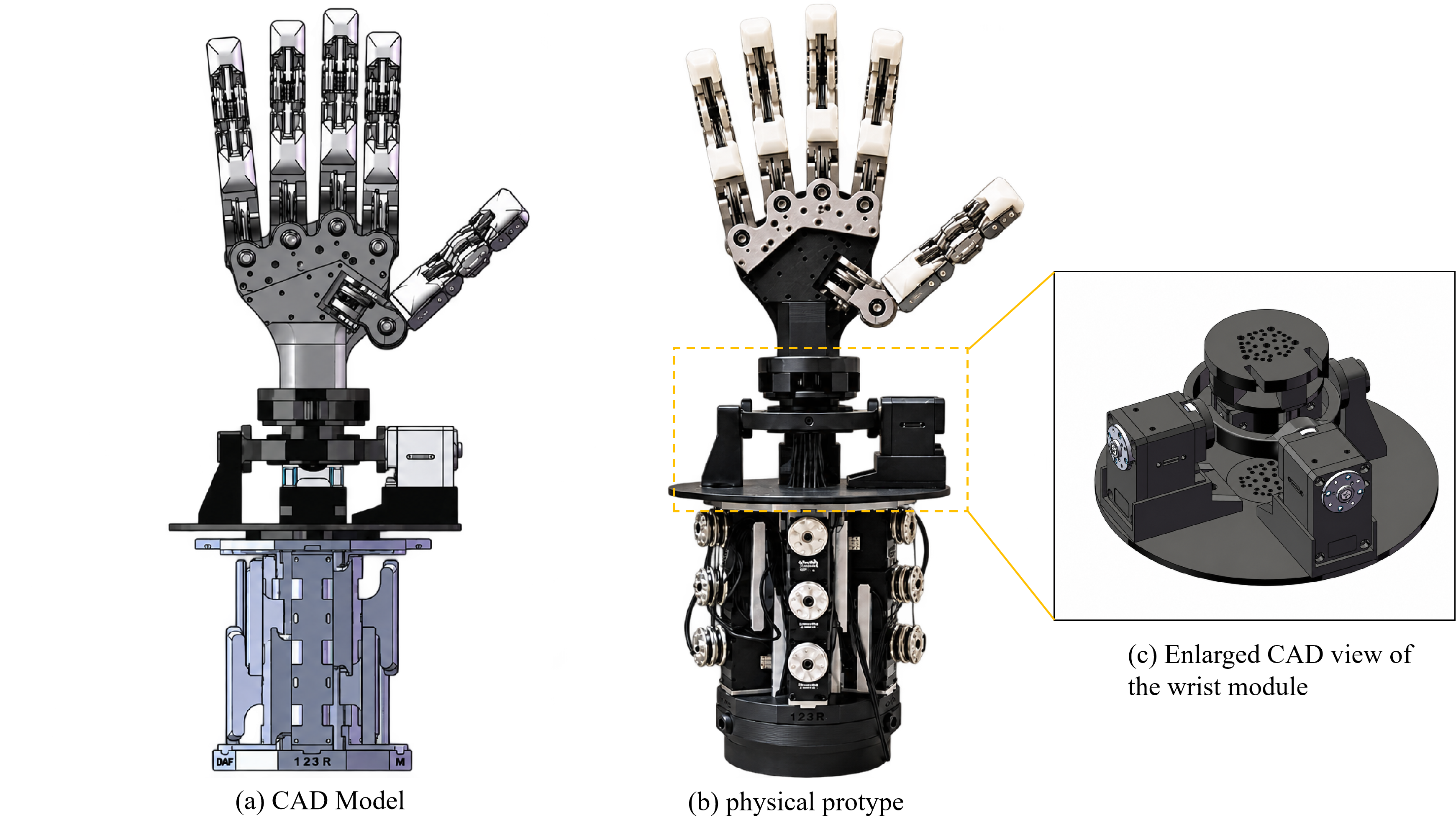
CRAFT-W mounts between the arm and the tendon-driven CRAFT Hand. Its two direct-drive axes add local orientation control while keeping the hand itself unchanged.
See the coupling question02 / Physical evidence
Switch tasks to see where local orientation enters the manipulation loop.
Task 01 / local correction
Aligns the hammer head with the nail axis before impact and restores alignment between strokes while the arm drives the strike.
Wrist-locked versus actively controlled trials (W0 / W1 / W2) will isolate the value and cost of the added DoF.
03 / Mechanical design
A compact extension designed around the existing hand, tendon route, and service needs.
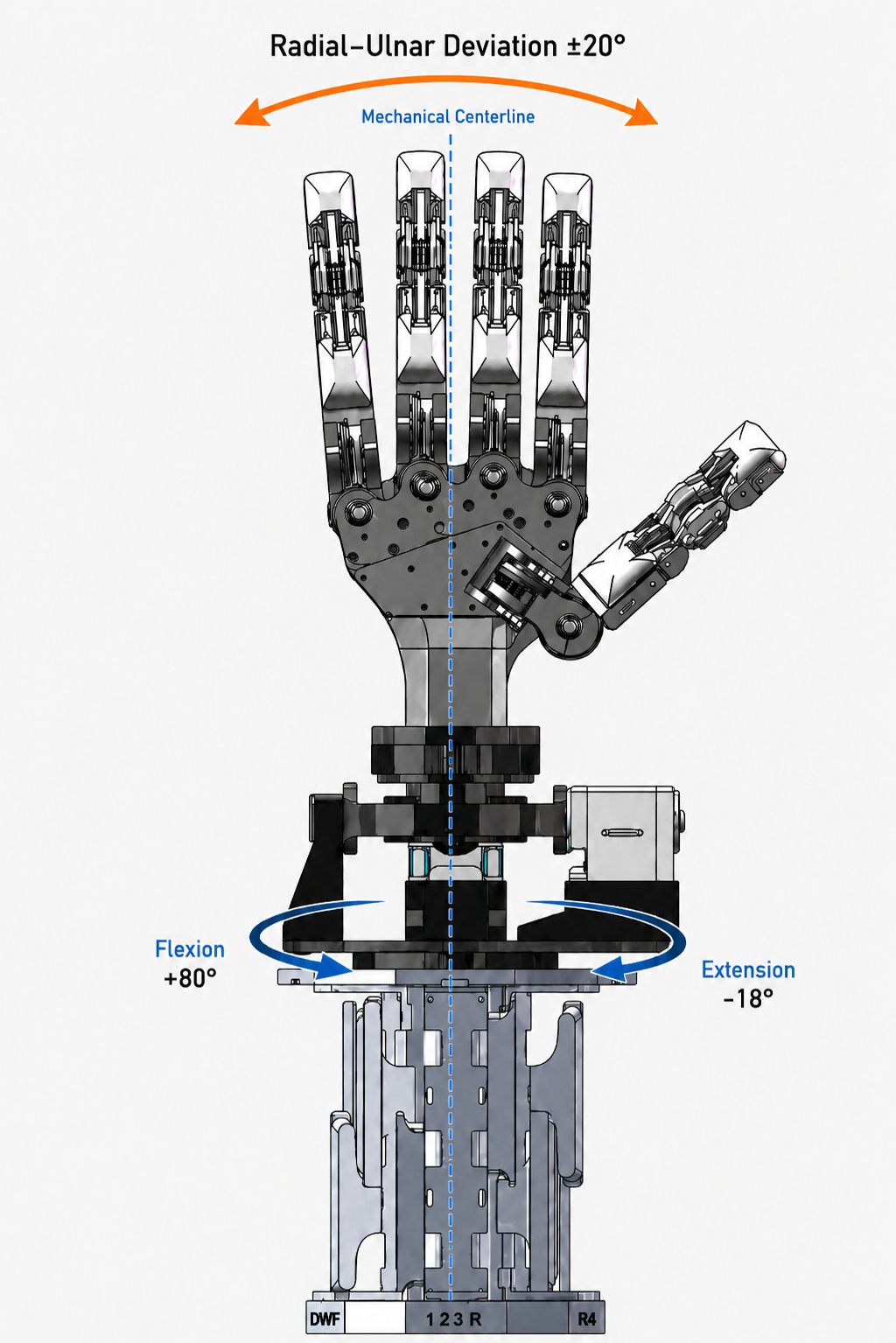
The wrist carries the distal hand as an independent module, so the existing hand mechanics, electronics, and finger-control stack remain intact.
Bending and axial rotation share a compact wrist center instead of stacking a long serial chain.
Two XC430-T240BB-T servos create short, deterministic load paths with position control and current limiting.
An independent frame carries the distal hand while leaving the CRAFT Hand's mechanics and finger-control stack unchanged.
04 / Coupling characterization
The paper treats wrist–finger coupling as a preliminary mechanical characterization—not a complete identification.
Experimental setup
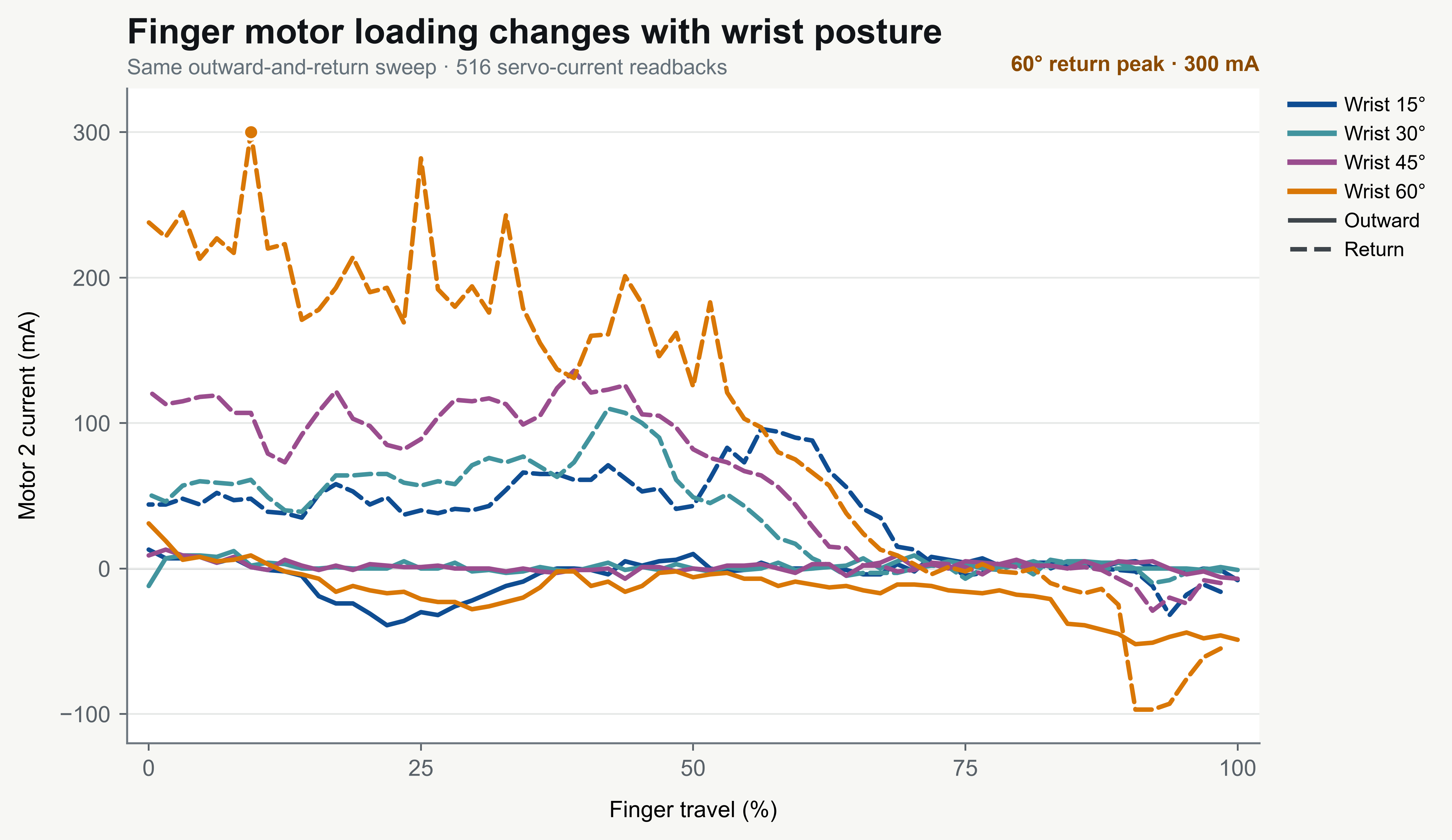
The wrist was fixed at 15°, 30°, 45°, and 60° while finger motor 2 followed the same outward-and-return sweep.
The finger reached its prescribed travel at every posture. The comparison therefore asks how wrist posture changes motor loading, rather than whether the hand can still move.
Result
Return loading was similar at 15° and 30°, increased at 45°, and was largest at 60°, where peak current reached 300 mA. No over-current event occurred.
Interpretation
The separation between outward and return traces is consistent with tendon friction, routing hysteresis, or local stick–slip motion.
Limit
With one sweep per posture and no current-to-torque calibration, these measurements remain preliminary rather than a complete mechanical identification.
05 / Build from the work
Select a resource to see what is available now and what is being prepared.
06 / Reference
The manuscript is in preparation. This provisional citation will be replaced with the public record when released.
@misc{pang2026craftw,
  title = {CRAFT-W: A Direct-drive
           Two-DoF Wrist Extension for
           the CRAFT Hand},
  author = {Pang, Yujie and
            Sakib, Sadman and Al Faruque,
            Mohammad Abdullah},
  year = {2026},
  howpublished = {Manuscript in preparation}
}